Showing posts with label Rhythm. Show all posts

Thursday, July 28, 2011

The Stolen Smile

Lewis, J. Patrick. The stolen smile. Illustrated by Gary Kelley. Mankato, Minn: Creative Editions, 2004. ISBN: 978-1568461922.

Author Website: http://www.jpatricklewis.com/

Illustrator Website: http://www.garykelleyonline.com/

Media: Pastel and Oil Paint

Use of Rhythm: (p. 3) “villain or victim? / Victor or vanquished?” / Savior or scoundrel?”

Use of Simile: (p. 20) “scratched their heads like monkeys.”

Use of Alliteration: (p. 3) “villain or victim? / Victor or vanquished?” / Savior or scoundrel?” (p. 5) “depths of delirium,”

Use of Metaphor: (p. 5) “I am drowning in gifts, flowers, tokens of love,”

Curricular Connection: Visual and Performing Arts Content Standards, Grades 9-12, 1.0 Artistic Perception: Processing, Analyzing, and Responding to Sensory Information Through the Language and Skills Unique to the Visual Arts Students perceive and respond to works of art, objects in nature, events, and the environment. They also use the vocabulary of the visual arts to express their observations.

Annotation: Author J. Patrick Lewis imagines the mindset of thief Vicenzo Peruggia, who stole the Mona Lisa in 1911. Peruggia walks readers through his daring theft and imagines the reactions of the world to the loss of da Vinci’s famous work.

Personal Reaction: 2011 Children’s Poet Laureate J. Patrick Lewis offers an interesting perspective on the real theft of Leonardo da Vinci’s painting, the Mona Lisa, from the Louvre Museum in 1911. Lewis offers the thief, Vicenzo Peruggia, as a narrator for this picture book for older readers. Reminiscing from his jail cell, Peruggia walks readers through the details of his bold undertaking, explaining that he actually used to work for the Louvre and had personally installed the protective glass over the Mona Lisa. Peruggia’s reason for the theft is to return Italian da Vinci’s masterpiece to Italy. When Peruggia attempts to sell the painting to an Italian collector, readers learn more about Peruggia’s unstable state of mind. Peruggia is surprised to learn that da Vinci personally sold the painting to the King of France and that Italy does share Peruggia’s sense of rightful ownership of the famous smiling lady. Gary Kelley’s illustrations are well-executed and worthy of a book about fine art. Kelley’s close up illustration of the Louvre director’s shocked face upon discovering the theft covers a full page and requires no text (p. 12). As museum employees search for the Mona Lisa, readers get a mini tour of the Louvre’s Oriental Art, Renaissance, sculpture and Egyptian galleries. My favorite illustration appears on pages 22 and 23 and shows a Parisian sidewalk café filled with café goers sipping coffee and reading newspapers which all show the theft as the front page story. Kelley’s paintings are fluid and full of color and shadows and the effect is lively and engaging. The end notes provide information about the Mona Lisa, the painting scene during the time of da Vinci, as well as an overview of the Louvre Museum and Uffizi Gallery.

Paul Revere's Ride

Longfellow, Henry Wadsworth. Paul Revere's Ride. Illustrated by Ted Rand. Perfection Learning Prebound, 2008. ISBN: 978-0140556124

Author Website: None

Illustrator Website: None

Media: Black Ink and Watercolor Paint

Use of Rhythm and Rhyme: (throughout book, example from p. 7) “Listen, my children, and you shall hear / Of the midnight ride of Paul Revere, / On the eighteenth of April, in Seventy-five; / Hardly a man is now alive / Who remembers that day and year.”

Use of Simile: (p. 11) “across the moon like a prison bar.”

Use of Alliteration: (p. 13) “wanders and watches.” (p. 17) “Masses and moving shapes of shade-“ “pigeons from their perch,” (p. 23) “spectral and somber and still.”

Use of Metaphor: (p. 23) “kindled the land into flame with its heat.”

Special Notations: Poem

Curricular Connection: History Social-Science Content Standards for California, Grade Five, Standard 5.6 Students understand the course and consequences of the American Revolution: 1. Identify and map the major military battles, campaigns, and turning points of the Revolutionary War, the roles of the American and British leaders, and the Indian leaders’ alliances on both sides.

Annotation: Henry Wadsworth Longfellow’s famous poem recounting the midnight ride of Paul Revere to warn the colonial rebels of British troop activity is paired with sweeping watercolor paintings to beautiful effect.

Personal Reaction: Like most American school children, I studied the American Revolution and one of my most vivid memories of this unit of study was learning about Paul Revere’s midnight ride. Paul Revere was one of many Americans who acted bravely in 1775, but he is more remembered than many, perhaps because of the drama of his ride to warn that the British were coming and perhaps, later, because of Longfellow’s memorable poem about the event. Ted Rand shares Longfellow’s famous poem and adds his own drama with watercolor illustrations that seem both poured across the pages and reminiscent of revolutionary times, thanks to color choices that project the look of young Boston. Rand also adds a history note at the end of book with details not found in Longfellow’s poem, introducing readers to some of the other players involved in Revere’s famous message. Revere’s friend Robert Newman waited in the Old North Church to give Revere the signal, “If the British march / By land or sea from the town tonight, / Hang a lantern aloft the belfry arch / Of the North Church tower as a signal light - / One, if by land, and two, if by sea;” (p. 9). When I visited the actual Old North Church in Boston a year ago, Longfellow’s words came into my head as I stood looking at the spot where Newman stood with his lantern flashing a signal to Revere. Longfellow’s memorable words are a wonderful introduction to not only Revere’s ride to Concord, but to the mood during that time period. Longfellow’s work, illustrated by Rand, would be well paired with Stephen Krensky’s Paul Revere’s Midnight Ride for a comparative literature lesson or as supplemental reading for students studying the American Revolution.

Friday, July 22, 2011

Coraline

Russell, P. Craig and Gaiman, Neil. Coraline. Colored by Lovern Kindzierski, lettered by Todd KleinNew York: HarperCollins, 2008. ISBN: 978-0-06-082543-0.

Author / Illustrator Website: http://www.artofpcraigrussell.com/ (Russell)

Author Website: http://www.neilgaiman.com/ (Gaiman).

Awards: School Library Journal Best Book. ALA Booklist Editors’ Choice.

Media: Ink and watercolor.

Use of Onomatopoeia: (P. 12) “KREEE. . . . . . .EEAAAK.”

Use of Simile: (p. 23) “The mist hung like blindness around the house.” (p. 71) “a tiny doubt inside her, like a maggot in an apple core,”

Use of Repetition, Rhythm and Rhyme : (p. 14) “We are small, but we are many, we are many, we are small. We were here, before you rose, we will be here, when you fall.”

Special Notations: 2009 Students’ List, Graphic Novel (Fiction)

Annotation: Coraline is bored after moving to a new home and her parents never seem to have time for her. Everything changes when Coraline discovers a mysterious door and a creepy parallel world in the empty flat next door.

Personal Reaction: “Because when you’re scared but you still do it anyway, that’s brave,” (p.67) Coralline tells herself as she pushes herself to search for her missing parents. Coraline’s parents never seemed to have time to play and they were fond of rules and dinners made from recipes. Coraline longs for adventure and she certainly gets it when she discovers an empty flat (apartment) next to her own family’s flat. Coraline meets her “other mother and father,” creepy versions of her real parents who have black buttons for eyes. These other parents have all the time in the world for Coraline if only Coraline will let them sew black buttons on her eyes. Graphic novel adapter Craig uses one of these same buttons to “dot” the “i” in the title Coraline on the cover. The other parents also steal away Coraline’s real parents. Coraline meets a host of unusual characters in her new home and these same characters’ not quite right mirror images in the strange and frightening mirror world on the other side of the door. In the end, Coraline comes to realize that she is strong enough to overcome her fears and she learns to appreciate the boundaries set by her parents. This graphic novel adaptation stands on it own based on the strength of Craig’s drawings and character development. Craig judiciously uses bright colors to highlight toys, books, videos and a theater marquee in the book while the majority of the illustrations feature a gloomy, ominous color palette. On page 173, Coraline pulls out her old dolls and tells her mother that “they’re protective coloration,” as she plots to defeat her “other mother.” I am a Gaiman fan and missed some of the details in the original Coraline, but Craig succeeds in conveying the frightening mood of Gaiman’s original and maximizes certain aspects of the story, such as Coraline’s curiosity and penchant for following her dreams, which are often nightmarish.

Wednesday, July 13, 2011

For Liberty: The Story of the Boston Massacre

Decker, Timothy. For Liberty: The Story of the Boston Massacre.

Asheville, North Carolina: Front Street Press, 2009. ISBN: 9781590786086.

Author/Illustrator Website: www.timothydecker.com

Media: pen and ink

Awards and Honors: 2009 Cybil Nominated title for Non Fiction (MG/YA)

Use of Onomatopoeia:

"Bells pealed throughout the city."

"They could hear the growing din as the talked."

"The throng of colonists grew as did the roar of their cries."

"The bells continued to ring as if signaling the new tragedy."

Use of Sophisticated Language:

"Quarter no fiendish soldiers in your homes. Welcome no ill bred thieves to your hearth. Protect your liberties in this doleful and dark time."

"...soldiers quartered in a populous town, will always occasion two mobs where they prevent one. They are wretched conservators of the peace."

Use of Rhythm/Repetition:

"The mob swelled.

The reasonable men went home.

The bellicose remained."

"Surely the mob would not assault a trained soldier.

Surely his men would not fire for fear of shooting their officer.

Certainly a show of force would dissolve the anger."

Curricular Connection: 5th Grade History/ Social Studies, California State Board of Education Standards, 5.5: Students explain the causes of the American Revolution: 1. Understand how political, religious, and economic ideas and interests brought about the Revolution (e.g., resistance to imperial policy, the Stamp Act, the Townshend Acts, taxes on tea, Coercive Acts).

Annotation: A stark, graphic novel style account of the Boston Massacre, one most significant events in the lead up to the Revolutionary War.

Personal Reaction: The Boston Massacre was a serious event with sweeping repercussions for the city of Boston, the colonies and England. Decker honors the gravity of this confusing evening that made the history books by keeping his graphic novel style drawings simple and spare. Readers come to understand that this massacre actually began after a great deal of pent up emotion and anger over taxes on the colonists side and colonist abuse of the British soldiers on the British side. Students gain insight into the mindset of young Private White who cries “fire,” in a moment of stress and aggravation. The consequences of this moment are a rebellion, the death of five men and a trial watched by all. This book offers and excellent opportunity to teach students about the American legal system. None other than John Adams defends the British soldiers responsible for firing on an angry mob of colonists, not because he sided with the British, but because he believed in the right to a fair trial and counsel. For Liberty is a nice, contemporary styled book to introduce the study of the American Revolution. It also works nicely as a supplemental source for a biography study of John Adams.

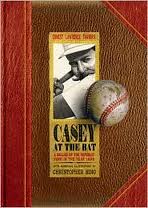
Ernest L. Thayer's Casey at the Bat: a Ballad of the Republic Sung in the Year 1888

Thayer, Ernest Lawrence and Bing, Christopher. Ernest L. Thayer's Casey at the bat: a ballad of the Republic sung in the year 1888. Illustrated by Christopher H. Bing. Brooklyn, NY: Handprint Books, 2000. ISBN: 978-1929766000.

Author and Illustrator Website: http://www.christopherbing.com/Site/Welcome_.html

Awards: Caldecott Honor Book, 2001.

Media: Sepia pen and ink drawings that resemble an engraved scrapbook and photographs.

Use of Alliteration: “sickly silence,” “deep despair,”

Use of Onomatopoeia: “get a whack at that,”

Use of Rhyme: (entire book, rhyme scheme: last word of each line, aa bb cc) “The outlook wasn't brilliant for the Mudville nine that day / The score stood four to two with but one inning more to play”

Use of Rhythm: (entire book) “There was ease in Casey's manner as he stepped into his place / There was pride in Casey's bearing and a smile on Casey's face . . .

Use of Simile: a muffled roar / Like the beating of the storm-waves on a stern and distant shore.”

Special Notations: Poem

Annotation: Author illustrator Christopher Bing takes a swing at sharing Ernest Thayer‘s famous poem about a baseball player named Casey with a new generation. Bing hits a homerun with his nostalgic drawings intended to replicate a scrapbook.

Personal Reaction: Bing’s fresh presentation of Edward Thayer’s poem from the 1800’s is absolute proof of the value of illustrations. Thayer’s famous poem can be enjoyed by a whole new generation thanks to Bing’s idea of pairing it with sepia pen and ink drawings intended to resemble a scrapbook from the 1880’s. Bing makes the poem the centerpiece for an historical baseball experience that older readers will find captivating. I found myself bypassing the actual poem the first time I opened this book because I was so entranced by Casey’s creation of “The Mudville Sunday Monitor,” a fictional 1880’s newspaper. I wouldn’t call myself a sports fan, but I enjoy history and this book gave me a wonderful, authentic-feeling sense of the issues of the day as they impacted baseball. During my second reading, I enjoyed revisiting Thayer’s exciting and heartbreaking tale of Casey’s unexpected strikeout. This book would be a great pick for a reluctant reader who is a baseball fan, as well as a nice introduction to America’s favorite pastime for anyone, but particularly history buffs.

Tuesday, July 12, 2011

Ellington Was Not a Street

Shange, Ntozake. Ellington was not a street. Illustrated by Kadir Nelson. New York: Simon & Schuster Books for Young Readers, 2004. ISBN: 0-689-82884-5

Author Website: http://www.ntozakeshange.org/home.html

Illustrator Website: http://www.kadirnelson.com/

Media: Oil Paint.

Use of Rhythm: (entire book) “it hasn’t always been this way / ellington was not a street / Robeson no mere memory . . . “

Use of Simile: (p. 20) “politics as necessary as collards.” (p. 24) “our doors opened like our daddy’s arms.”

Special Notations: Poem

Curricular Connection: California Standards for Visual and Performing Arts, Grade Six, Standard 3.0: Understanding the historical contributions and cultural dimensions of music.

Annotation: Poet author Shange recounts her memories of eight famous African-American musicians, politicians and writers who socialized with her father and frequently visited her childhood home. Shange laments that these men may have been forgotten.

Personal Reaction: Kadir Nelson’s oil portraits in Ellington Was Not a Street bring this picture book for older readers alive. The illustrator so accurately captures the faces of the eight famous African American men described by poet Shange in her poem Mood Indigo that the illustrations resemble photographs. Nelson uses light and shadow and a broad palette of warm tones to depict the faces in this story; readers will notice the finely drawn cheekbones, expressive eyes, details such as a slight gap between two front teeth and be transported back to the times of Shange’s childhood. Nelson’s paintings made me want to learn more about these men whom Shange had been fortunate enough to meet. Shange can be seen as a young child, always in a sky blue dress, on each page as she narrates the comings and goings of Renaissance man Robeson, writer Dubois, Percussionist Baretto, singer Tilghman, jazz musician Gillespie, politician Nkrumah, musician Ellington, boxer Akins and vocal group, The Clovers. The poem explains that the author’s father was a friend of these perhaps now forgotten African-American movers and shakers. Today, Ellington is a name on a street sign, but that street was named after a man known as the Duke of Jazz who won the Presidential Medal of Freedom, Shange reminds readers. A brief biography of Ellington and the others is provided at the back of this picture book that is clearly intended for older readers learning about African American culture and its contributions. Readers can look for Nelson’s depiction of Shange as a grown woman in illustrations of the actual street named after Ellington (pages 5 and 13). Ellington Was Not a Street would be an excellent book for introducing a lesson on music history or for generating a discussion about family heritage and influence.