Showing posts with label Rhyme. Show all posts

Sunday, July 31, 2011

The Cats in Krasinski Square

Hesse, Karen. The cats in Krasinski Square. Illustrated by Wendy Watson. New York: Scholastic Press, 2004. ISBN: 978-0439435406.

Author Website: None

Illustrator Website: http://www.wendy-watson.com/

Awards: Notable Social Studies Trade Books for Young People, 2005. California Young Readers Medal, Picture Books for Older Readers, 2007.

Media: Watercolor Paint on Paper

Use of Rhyme: (p. 8) “I have no food to spare. / The cats don’t care.”

Use of Personification: (p. 15) “the big room dances with light.”

Use of Repetition: (p. 11, p. 19) “I wear my Polish Look, / I walk my Polish Walk.”

Special Notations: Poem

Curricular Connection: History Social-Science Content Standards for California, Grade Five, Standard 10.8, Students analyze the causes and consequences of World War II: 5. Analyze the Nazi policy of pursuing racial purity, especially against the European Jews; its transformation into the Final Solution; and the Holocaust that resulted in the murder of six million Jewish civilians.

Annotation: A young Jewish girl manages to pass as Polish and live just outside the Warsaw Ghetto walls. The girl befriends numerous stray cats that eventually play a role in a Jewish Resistance effort.

Personal Reaction: “I wear my Polish Look, / I walk my Polish Walk.” (p. 11) says the young, Jewish narrator passing for Polish in this moving story about the Warsaw Ghetto. In late 1939, the Jewish population in Warsaw was forced to live in an area just over one square mile in size, divided by a wall from the rest of Warsaw. During the next few years, the Gestapo committed atrocity after atrocity against the Jewish population in Warsaw. The Jewish Resistance fought back in spite of food shortages, overcrowding and disease in the Ghetto. Newbery Medal award-winner Hesse uses poetry and the viewpoint of a young girl who manages to pass for Polish and live just outside the Ghetto to tell this heartbreaking story. The girl has befriended dozens of stray cats and comes up with a plan to use the cats to disrupt the Gestapo’s (German police) efforts against the Jewish Resistance. The girl’s older sister, Mira, and her friends have coordinated a large-scale food smuggling scheme to help the people in the Ghetto. The girl gathers the cats and lets them loose in a train station to prevent the Gestapo from interfering with the food distribution to Ghetto residents. I was touched by the poetic quality that Hesse uses to tell a story that references a period of great horror. Watson’s watercolor illustrations in gray, red, orange and yellow hues support the beauty in the young girl’s actions and the bravery of the Jews who fought back against the Gestapo. An author note and historical note at the back of the book provide details about a real life incident involving cats in Warsaw that inspired Hesse to write this story, as well as factual background data about the Warsaw Ghetto.

Thursday, July 28, 2011

Paul Revere's Ride

Longfellow, Henry Wadsworth. Paul Revere's Ride. Illustrated by Ted Rand. Perfection Learning Prebound, 2008. ISBN: 978-0140556124

Author Website: None

Illustrator Website: None

Media: Black Ink and Watercolor Paint

Use of Rhythm and Rhyme: (throughout book, example from p. 7) “Listen, my children, and you shall hear / Of the midnight ride of Paul Revere, / On the eighteenth of April, in Seventy-five; / Hardly a man is now alive / Who remembers that day and year.”

Use of Simile: (p. 11) “across the moon like a prison bar.”

Use of Alliteration: (p. 13) “wanders and watches.” (p. 17) “Masses and moving shapes of shade-“ “pigeons from their perch,” (p. 23) “spectral and somber and still.”

Use of Metaphor: (p. 23) “kindled the land into flame with its heat.”

Special Notations: Poem

Curricular Connection: History Social-Science Content Standards for California, Grade Five, Standard 5.6 Students understand the course and consequences of the American Revolution: 1. Identify and map the major military battles, campaigns, and turning points of the Revolutionary War, the roles of the American and British leaders, and the Indian leaders’ alliances on both sides.

Annotation: Henry Wadsworth Longfellow’s famous poem recounting the midnight ride of Paul Revere to warn the colonial rebels of British troop activity is paired with sweeping watercolor paintings to beautiful effect.

Personal Reaction: Like most American school children, I studied the American Revolution and one of my most vivid memories of this unit of study was learning about Paul Revere’s midnight ride. Paul Revere was one of many Americans who acted bravely in 1775, but he is more remembered than many, perhaps because of the drama of his ride to warn that the British were coming and perhaps, later, because of Longfellow’s memorable poem about the event. Ted Rand shares Longfellow’s famous poem and adds his own drama with watercolor illustrations that seem both poured across the pages and reminiscent of revolutionary times, thanks to color choices that project the look of young Boston. Rand also adds a history note at the end of book with details not found in Longfellow’s poem, introducing readers to some of the other players involved in Revere’s famous message. Revere’s friend Robert Newman waited in the Old North Church to give Revere the signal, “If the British march / By land or sea from the town tonight, / Hang a lantern aloft the belfry arch / Of the North Church tower as a signal light - / One, if by land, and two, if by sea;” (p. 9). When I visited the actual Old North Church in Boston a year ago, Longfellow’s words came into my head as I stood looking at the spot where Newman stood with his lantern flashing a signal to Revere. Longfellow’s memorable words are a wonderful introduction to not only Revere’s ride to Concord, but to the mood during that time period. Longfellow’s work, illustrated by Rand, would be well paired with Stephen Krensky’s Paul Revere’s Midnight Ride for a comparative literature lesson or as supplemental reading for students studying the American Revolution.

Friday, July 22, 2011

Coraline

Russell, P. Craig and Gaiman, Neil. Coraline. Colored by Lovern Kindzierski, lettered by Todd KleinNew York: HarperCollins, 2008. ISBN: 978-0-06-082543-0.

Author / Illustrator Website: http://www.artofpcraigrussell.com/ (Russell)

Author Website: http://www.neilgaiman.com/ (Gaiman).

Awards: School Library Journal Best Book. ALA Booklist Editors’ Choice.

Media: Ink and watercolor.

Use of Onomatopoeia: (P. 12) “KREEE. . . . . . .EEAAAK.”

Use of Simile: (p. 23) “The mist hung like blindness around the house.” (p. 71) “a tiny doubt inside her, like a maggot in an apple core,”

Use of Repetition, Rhythm and Rhyme : (p. 14) “We are small, but we are many, we are many, we are small. We were here, before you rose, we will be here, when you fall.”

Special Notations: 2009 Students’ List, Graphic Novel (Fiction)

Annotation: Coraline is bored after moving to a new home and her parents never seem to have time for her. Everything changes when Coraline discovers a mysterious door and a creepy parallel world in the empty flat next door.

Personal Reaction: “Because when you’re scared but you still do it anyway, that’s brave,” (p.67) Coralline tells herself as she pushes herself to search for her missing parents. Coraline’s parents never seemed to have time to play and they were fond of rules and dinners made from recipes. Coraline longs for adventure and she certainly gets it when she discovers an empty flat (apartment) next to her own family’s flat. Coraline meets her “other mother and father,” creepy versions of her real parents who have black buttons for eyes. These other parents have all the time in the world for Coraline if only Coraline will let them sew black buttons on her eyes. Graphic novel adapter Craig uses one of these same buttons to “dot” the “i” in the title Coraline on the cover. The other parents also steal away Coraline’s real parents. Coraline meets a host of unusual characters in her new home and these same characters’ not quite right mirror images in the strange and frightening mirror world on the other side of the door. In the end, Coraline comes to realize that she is strong enough to overcome her fears and she learns to appreciate the boundaries set by her parents. This graphic novel adaptation stands on it own based on the strength of Craig’s drawings and character development. Craig judiciously uses bright colors to highlight toys, books, videos and a theater marquee in the book while the majority of the illustrations feature a gloomy, ominous color palette. On page 173, Coraline pulls out her old dolls and tells her mother that “they’re protective coloration,” as she plots to defeat her “other mother.” I am a Gaiman fan and missed some of the details in the original Coraline, but Craig succeeds in conveying the frightening mood of Gaiman’s original and maximizes certain aspects of the story, such as Coraline’s curiosity and penchant for following her dreams, which are often nightmarish.

Wednesday, July 13, 2011

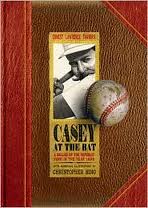
Ernest L. Thayer's Casey at the Bat: a Ballad of the Republic Sung in the Year 1888

Thayer, Ernest Lawrence and Bing, Christopher. Ernest L. Thayer's Casey at the bat: a ballad of the Republic sung in the year 1888. Illustrated by Christopher H. Bing. Brooklyn, NY: Handprint Books, 2000. ISBN: 978-1929766000.

Author and Illustrator Website: http://www.christopherbing.com/Site/Welcome_.html

Awards: Caldecott Honor Book, 2001.

Media: Sepia pen and ink drawings that resemble an engraved scrapbook and photographs.

Use of Alliteration: “sickly silence,” “deep despair,”

Use of Onomatopoeia: “get a whack at that,”

Use of Rhyme: (entire book, rhyme scheme: last word of each line, aa bb cc) “The outlook wasn't brilliant for the Mudville nine that day / The score stood four to two with but one inning more to play”

Use of Rhythm: (entire book) “There was ease in Casey's manner as he stepped into his place / There was pride in Casey's bearing and a smile on Casey's face . . .

Use of Simile: a muffled roar / Like the beating of the storm-waves on a stern and distant shore.”

Special Notations: Poem

Annotation: Author illustrator Christopher Bing takes a swing at sharing Ernest Thayer‘s famous poem about a baseball player named Casey with a new generation. Bing hits a homerun with his nostalgic drawings intended to replicate a scrapbook.

Personal Reaction: Bing’s fresh presentation of Edward Thayer’s poem from the 1800’s is absolute proof of the value of illustrations. Thayer’s famous poem can be enjoyed by a whole new generation thanks to Bing’s idea of pairing it with sepia pen and ink drawings intended to resemble a scrapbook from the 1880’s. Bing makes the poem the centerpiece for an historical baseball experience that older readers will find captivating. I found myself bypassing the actual poem the first time I opened this book because I was so entranced by Casey’s creation of “The Mudville Sunday Monitor,” a fictional 1880’s newspaper. I wouldn’t call myself a sports fan, but I enjoy history and this book gave me a wonderful, authentic-feeling sense of the issues of the day as they impacted baseball. During my second reading, I enjoyed revisiting Thayer’s exciting and heartbreaking tale of Casey’s unexpected strikeout. This book would be a great pick for a reluctant reader who is a baseball fan, as well as a nice introduction to America’s favorite pastime for anyone, but particularly history buffs.

Tuesday, July 5, 2011

Boxes for Katje

Fleming, Candace. Boxes for Katje. Illustrated by Stacey Dressen-McQueen. New York: Farrar, Straus and Giroux, 2003. ISBN: 0-374-30922-1

Author Website: http://www.candacefleming.com/

Illustrator Website: None

Media: Colored Pencil, Oil Pastel and Acrylic Paint.

Use of Rhyme: (p. 15) “sweet beat.”

Use of Metaphor: (p. 16) “They have five children who are skin and bone.”

Use of Alliteration: (p. 24) “tulip bulbs buried beneath the snow.”

Use of Repetition: (multiple pages) “There is plenty to share,” Katje says after every package delivery.

Special Notations: 2009 Students’ List.

Detailed Artwork Discussion: Stacey Dressen-McQueen used a combination of colored pencils and oil pastel and acrylic paints to illustrate Boxes for Katje. Every page of the story features multiple patterns reminiscent of fabrics and wallpapers popular during the 1930’s and 9140’s in Holland. The illustrations contain a great deal of movement and drawings of people are frequently superimposed on backgrounds of gardens, snow, cobblestone and grass. The drawings are rich in details; heads of lettuce growing in a garden are painted with depth and dimension, emphasizing the layers of leaves (p. 13). People “move” with exaggerated motions, adding even more movement to the drawings. When the postman delivers a box, his leg is drawn lifting way up in the air, giving him a jaunty gait, obvious from just one drawing (p. 18). Katje’s family and friends’ joy upon opening the boxes from America is made obvious by the scattered placement of the objects in the illustrations. By looking at Dressen-McQueen’s haphazard location of teddy bears, chocolate bars, socks and coats, the reader senses that Katje might have joyfully flung each object out of the box as she opened it. Vibrant coloring paints a picture of the village of Olst that is endearing and optimistic. Dressen-McQueen’s style of folk art using mixed media is lively and more than competently conveys the emotions of Fleming’s characters in this story.

Curricular Connection: English-Language Arts/Writing, History/Social Science, Grade 5, Students connect social studies through literature analysis.

Annotation: An aid organization in the United States connects a girl from Indiana with a young girl in Holland after World War II. Care packages from Rosie to Katje provide nourishment, clothing and joy for Katje and her friends and family.

Personal Reaction: Boxes for Katje is a deceptively simple picture book loaded with meaning and lessons about caring and helping. The story is based on the similar real life experience of author Fleming’s mother just after World War II. Fleming’s spin on the story features a young Indiana girl named Rosie who makes a connection with a young girl named Katje in Holland via an American aid organization. Katje’s village is suffering from food and supply shortages after the war and Rosie sends Katje a care package. Katje generously shares the contents of the package with the postal carrier and her family. The girls strike up a correspondence and Rosie sends more care packages. While the text is brief, it suggests much about the devastation of war, the impact on resources, the necessary rebuilding after war and human kindness. This story would be a nice introduction for students studying the impact of World War II on the home front in the U.S. or for students working on compare and contract writing skills. The lives of Rosie and Katje are well suited for a comparison assignment. Social studies students might also examine the role of aid organizations during and after wars.

Wednesday, June 29, 2011

Action Jackson

Greenberg, Jan and Jordan, Sandra. Action Jackson. Illustrated by Robert Andrew Parker. Brookfield, Conn: Roaring Brook Press, 2002. ISBN: 978-0312367510

Author Website: http://mowrites4kids.drury.edu/authors/greenberg/, http://www.jangreenbergsandrajordan.com/

Illustrator Website: None

Media: Watercolor

Awards: Robert F. Silbert Honor

Use of Alliteration: (p. 4) “scent of salt,” “blackberry bushes,”

Use of Onomatopoeia: (p. 7) “flies buzz,” “sliding doors rattle,” (p. 17) “Fireworks splatter of rosy pink.”

Use of Repetition: (p. 7-8) “Not Jackson.” (p. 23) “Some angry. Some confused. Some excited. Some filled,”

Use of Rhythm: (p. 20) “Paint, paint and more paint, dripping, pouring, flinging.”

Curricular Connection: California Standards for Visual Arts, Grade Five, Standard 1.0, Artistic Perception, 1.2: Identify and describe characteristics of representational, abstract, and nonrepresentational works of art.

Detailed Artwork Discussion: Robert Andrew Parker’s watercolor illustrations are simply beautiful and are the perfect means of communicating Jackson Pollack’s artistic genius. Parker imbues his art with the emotions of Jackson at every point in the story. We see Jackson’s messy collection of ordinary paint from the hardware story, drawn with messy dabs of watercolor (p. 9) and we feel the emotion of Pollack’s creative process in the black splatters of paint when he initiates “Lavender Mist,” (p. 11). On a day when Pollack doesn’t paint, but reflects on his work in progress, Parker uses light-filled colors of aqua and sandy beige to convey Pollack’s calm mood (p. 15). Telling Pollack’s story might be daunting for another artist, but Parker’s illustrations are superb and reinforce the power of Pollack’s art and art in general.

Annotation: Action Jackson is the story of how artist Jackson Pollack created his work entitled, “Lavender Mist.” The story offers insight into Pollack’s artistic inspiration and working style.

Personal Reaction: I’m a fan of Pollack’s work and I’ve seen a movie about him and viewed many of his works in museums, but this picture book gave me a unique sense of Pollack the artist at work. Greenberg and Jordan’s decision to show Pollack as he creates a single piece of work takes the reader into Pollack’s world. The reader understands the creative process, what it is about Pollack’s style that sets him apart and how he spends his time when he’s not painting. Details make this man’s life resonant: “If a penny fell out of his pocket, he would leave it. An insect lands in the wet paint, and there it stays,” (p. 19). The story ends with a photographic reproduction of Pollack’s actual finished piece, “Lavender Mist,” (p. 23) and a two-page biography of the artist (p. 28-29).

Saturday, June 25, 2011

Cinderella Skeleton

San Souci, Robert D. Cinderella Skeleton. Illustrated by David Catrow. New York: Silver Whistle, 2000. ISBN: 0-15-202003-9

Author Website: http://www.rsansouci.com/

Illustrator Website: http://www.catrow.com/

Video of Illustrator drawing Cinderella Skeleton: http://vimeo.com/6650302

Media: Pencil, Watercolor

Award: International Reading Association Children's Choices, 2001.

Use of Onomatopoeia: “Saw witch touch wand- Tip-tap!-to all.”

“Ignoring the thump of her footless stump.”

Use of Rhyme: The first line of each stanza always begins “Cinderella Skeleton,” and the rhyme scheme after is ABBCCA throughout.

Use of Repetition: : Throughout the story each stanza starts with Cinderella Skeleton.

Use of Alliteration: Throughout the poem repetition of the first letter of the word is used. Examples: Decayed, decrepit-what a fright.”

“And firmly packed with spite and spleen.”

Annotation: This picture book is a dark and twisted retelling of the fairytale Cinderella. In San Souci’s version of this beloved tale, Cinderella is a decaying skeleton with a webbed gown designed by spiders.

Personal Reaction: Cinderella Skeleton exemplifies how some picture books are definitely only for older readers. The rhyming story identifies Cinderella as a corpse and this potentially horrifying character is brought to life by Catrow’s dark, but whimsical, illustrations. Cinderella Skeleton is indeed a version of the classic fairytale, but this version is rated PG. The retelling of the story is dark and frightening, while the illustrations are sprinkled with humorous touches that lighten the mood of the story. The balance between San Souci's dark text and Catrow's illustrations results in a wonderful symmetry. I would recommend this version of Cinderella to older elementary school students who have read and enjoyed Neil Gaiman's The Graveyard, as both books have a voice that is similarly comfortable with death. Matching picture books for older readers with print books works well for this age group, in my opinion.

Thursday, June 9, 2011

Brave Margaret

San Souci, Robert D. Brave Margaret: an Irish adventure. Illustrated by Sally Wern Comport. New York: Simon & Schuster Books for Young Readers, 1999. ISBN: 0-689-81072-5

Awards: Best Children’s Book of the Year, Bank Street College of Education, 2000.

Author Website: None

Illustrator Website:

http://www.artatlargeinc.com/

Media: Dark colored pastels on paper.

Use of Simile: (p.2) “skin white as milk,” “cheeks ruddy as fire glow,”

Use of Rhyme: (p.22) “Fee, fum, fo, fay, What foolish mortal comes this way?”

Use of Onomatopoeia: (p.8) “The monster hissed but hesitated.”

Detailed Artwork Discussion: Comport’s dark and dramatic pastel illustrations bring the adventure and romance of Margaret’s story to life and signify that this picture book is for older readers. A close-up illustration of Simon and Margaret shows Simon’s hand gripping Margaret’s arms. Margaret is staring into Simon’s eyes and it is clear from the picture that the two are in love and that they are fearful of being separated. Without the illustration, the intensity of the pair’s relationship might not be visible to the reader. In another illustration, Comport depicts Margaret attacking the giant with the magic sword and the reader can see just how gigantic the hideous the giant is. The illustrations are filled with shadowy movement and are scary at times, conveying the emotions of the characters in ways that words alone cannot. I think that Margaret is truly on display as the fiery, red-haired heroine that she is in this artwork.

Annotation: In Brave Margaret, Caldecott Honor writer Robert San Souci brings alive a West Irish folktale reminiscent of Arthur and the Sword. Red-haired Margaret is hungry for adventure and convinces Simon, the son of a King, to take her on board his ship. Margaret proves to be a worthy sailor and wins Simon’s heart, as well.

Personal Reaction: This folktale would be appealing for 5th and 6th grade fans of mythology, the Percy Jackson series by Rick Riordan or Julia Golding’s The Companion Quartet. Margaret’s bravery and magical ability to defeat the giant and wear the silver ring that comes with a sword are similarly appealing to the characteristics of heroes in current popular fiction. I like that Margaret is the champion who defeats the giant, but that she is still free to express her love for Simon. Although this is an old folktale, the story has a modernity in that Margaret is free to be both a strong and feminine woman.