Showing posts with label Poem. Show all posts

Sunday, July 31, 2011

The Cats in Krasinski Square

Hesse, Karen. The cats in Krasinski Square. Illustrated by Wendy Watson. New York: Scholastic Press, 2004. ISBN: 978-0439435406.

Author Website: None

Illustrator Website: http://www.wendy-watson.com/

Awards: Notable Social Studies Trade Books for Young People, 2005. California Young Readers Medal, Picture Books for Older Readers, 2007.

Media: Watercolor Paint on Paper

Use of Rhyme: (p. 8) “I have no food to spare. / The cats don’t care.”

Use of Personification: (p. 15) “the big room dances with light.”

Use of Repetition: (p. 11, p. 19) “I wear my Polish Look, / I walk my Polish Walk.”

Special Notations: Poem

Curricular Connection: History Social-Science Content Standards for California, Grade Five, Standard 10.8, Students analyze the causes and consequences of World War II: 5. Analyze the Nazi policy of pursuing racial purity, especially against the European Jews; its transformation into the Final Solution; and the Holocaust that resulted in the murder of six million Jewish civilians.

Annotation: A young Jewish girl manages to pass as Polish and live just outside the Warsaw Ghetto walls. The girl befriends numerous stray cats that eventually play a role in a Jewish Resistance effort.

Personal Reaction: “I wear my Polish Look, / I walk my Polish Walk.” (p. 11) says the young, Jewish narrator passing for Polish in this moving story about the Warsaw Ghetto. In late 1939, the Jewish population in Warsaw was forced to live in an area just over one square mile in size, divided by a wall from the rest of Warsaw. During the next few years, the Gestapo committed atrocity after atrocity against the Jewish population in Warsaw. The Jewish Resistance fought back in spite of food shortages, overcrowding and disease in the Ghetto. Newbery Medal award-winner Hesse uses poetry and the viewpoint of a young girl who manages to pass for Polish and live just outside the Ghetto to tell this heartbreaking story. The girl has befriended dozens of stray cats and comes up with a plan to use the cats to disrupt the Gestapo’s (German police) efforts against the Jewish Resistance. The girl’s older sister, Mira, and her friends have coordinated a large-scale food smuggling scheme to help the people in the Ghetto. The girl gathers the cats and lets them loose in a train station to prevent the Gestapo from interfering with the food distribution to Ghetto residents. I was touched by the poetic quality that Hesse uses to tell a story that references a period of great horror. Watson’s watercolor illustrations in gray, red, orange and yellow hues support the beauty in the young girl’s actions and the bravery of the Jews who fought back against the Gestapo. An author note and historical note at the back of the book provide details about a real life incident involving cats in Warsaw that inspired Hesse to write this story, as well as factual background data about the Warsaw Ghetto.

Thursday, July 28, 2011

Paul Revere's Ride

Longfellow, Henry Wadsworth. Paul Revere's Ride. Illustrated by Ted Rand. Perfection Learning Prebound, 2008. ISBN: 978-0140556124

Author Website: None

Illustrator Website: None

Media: Black Ink and Watercolor Paint

Use of Rhythm and Rhyme: (throughout book, example from p. 7) “Listen, my children, and you shall hear / Of the midnight ride of Paul Revere, / On the eighteenth of April, in Seventy-five; / Hardly a man is now alive / Who remembers that day and year.”

Use of Simile: (p. 11) “across the moon like a prison bar.”

Use of Alliteration: (p. 13) “wanders and watches.” (p. 17) “Masses and moving shapes of shade-“ “pigeons from their perch,” (p. 23) “spectral and somber and still.”

Use of Metaphor: (p. 23) “kindled the land into flame with its heat.”

Special Notations: Poem

Curricular Connection: History Social-Science Content Standards for California, Grade Five, Standard 5.6 Students understand the course and consequences of the American Revolution: 1. Identify and map the major military battles, campaigns, and turning points of the Revolutionary War, the roles of the American and British leaders, and the Indian leaders’ alliances on both sides.

Annotation: Henry Wadsworth Longfellow’s famous poem recounting the midnight ride of Paul Revere to warn the colonial rebels of British troop activity is paired with sweeping watercolor paintings to beautiful effect.

Personal Reaction: Like most American school children, I studied the American Revolution and one of my most vivid memories of this unit of study was learning about Paul Revere’s midnight ride. Paul Revere was one of many Americans who acted bravely in 1775, but he is more remembered than many, perhaps because of the drama of his ride to warn that the British were coming and perhaps, later, because of Longfellow’s memorable poem about the event. Ted Rand shares Longfellow’s famous poem and adds his own drama with watercolor illustrations that seem both poured across the pages and reminiscent of revolutionary times, thanks to color choices that project the look of young Boston. Rand also adds a history note at the end of book with details not found in Longfellow’s poem, introducing readers to some of the other players involved in Revere’s famous message. Revere’s friend Robert Newman waited in the Old North Church to give Revere the signal, “If the British march / By land or sea from the town tonight, / Hang a lantern aloft the belfry arch / Of the North Church tower as a signal light - / One, if by land, and two, if by sea;” (p. 9). When I visited the actual Old North Church in Boston a year ago, Longfellow’s words came into my head as I stood looking at the spot where Newman stood with his lantern flashing a signal to Revere. Longfellow’s memorable words are a wonderful introduction to not only Revere’s ride to Concord, but to the mood during that time period. Longfellow’s work, illustrated by Rand, would be well paired with Stephen Krensky’s Paul Revere’s Midnight Ride for a comparative literature lesson or as supplemental reading for students studying the American Revolution.

Wednesday, July 13, 2011

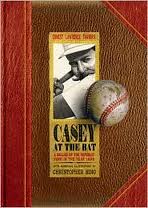
Ernest L. Thayer's Casey at the Bat: a Ballad of the Republic Sung in the Year 1888

Thayer, Ernest Lawrence and Bing, Christopher. Ernest L. Thayer's Casey at the bat: a ballad of the Republic sung in the year 1888. Illustrated by Christopher H. Bing. Brooklyn, NY: Handprint Books, 2000. ISBN: 978-1929766000.

Author and Illustrator Website: http://www.christopherbing.com/Site/Welcome_.html

Awards: Caldecott Honor Book, 2001.

Media: Sepia pen and ink drawings that resemble an engraved scrapbook and photographs.

Use of Alliteration: “sickly silence,” “deep despair,”

Use of Onomatopoeia: “get a whack at that,”

Use of Rhyme: (entire book, rhyme scheme: last word of each line, aa bb cc) “The outlook wasn't brilliant for the Mudville nine that day / The score stood four to two with but one inning more to play”

Use of Rhythm: (entire book) “There was ease in Casey's manner as he stepped into his place / There was pride in Casey's bearing and a smile on Casey's face . . .

Use of Simile: a muffled roar / Like the beating of the storm-waves on a stern and distant shore.”

Special Notations: Poem

Annotation: Author illustrator Christopher Bing takes a swing at sharing Ernest Thayer‘s famous poem about a baseball player named Casey with a new generation. Bing hits a homerun with his nostalgic drawings intended to replicate a scrapbook.

Personal Reaction: Bing’s fresh presentation of Edward Thayer’s poem from the 1800’s is absolute proof of the value of illustrations. Thayer’s famous poem can be enjoyed by a whole new generation thanks to Bing’s idea of pairing it with sepia pen and ink drawings intended to resemble a scrapbook from the 1880’s. Bing makes the poem the centerpiece for an historical baseball experience that older readers will find captivating. I found myself bypassing the actual poem the first time I opened this book because I was so entranced by Casey’s creation of “The Mudville Sunday Monitor,” a fictional 1880’s newspaper. I wouldn’t call myself a sports fan, but I enjoy history and this book gave me a wonderful, authentic-feeling sense of the issues of the day as they impacted baseball. During my second reading, I enjoyed revisiting Thayer’s exciting and heartbreaking tale of Casey’s unexpected strikeout. This book would be a great pick for a reluctant reader who is a baseball fan, as well as a nice introduction to America’s favorite pastime for anyone, but particularly history buffs.

Tuesday, July 12, 2011

Ellington Was Not a Street

Shange, Ntozake. Ellington was not a street. Illustrated by Kadir Nelson. New York: Simon & Schuster Books for Young Readers, 2004. ISBN: 0-689-82884-5

Author Website: http://www.ntozakeshange.org/home.html

Illustrator Website: http://www.kadirnelson.com/

Media: Oil Paint.

Use of Rhythm: (entire book) “it hasn’t always been this way / ellington was not a street / Robeson no mere memory . . . “

Use of Simile: (p. 20) “politics as necessary as collards.” (p. 24) “our doors opened like our daddy’s arms.”

Special Notations: Poem

Curricular Connection: California Standards for Visual and Performing Arts, Grade Six, Standard 3.0: Understanding the historical contributions and cultural dimensions of music.

Annotation: Poet author Shange recounts her memories of eight famous African-American musicians, politicians and writers who socialized with her father and frequently visited her childhood home. Shange laments that these men may have been forgotten.

Personal Reaction: Kadir Nelson’s oil portraits in Ellington Was Not a Street bring this picture book for older readers alive. The illustrator so accurately captures the faces of the eight famous African American men described by poet Shange in her poem Mood Indigo that the illustrations resemble photographs. Nelson uses light and shadow and a broad palette of warm tones to depict the faces in this story; readers will notice the finely drawn cheekbones, expressive eyes, details such as a slight gap between two front teeth and be transported back to the times of Shange’s childhood. Nelson’s paintings made me want to learn more about these men whom Shange had been fortunate enough to meet. Shange can be seen as a young child, always in a sky blue dress, on each page as she narrates the comings and goings of Renaissance man Robeson, writer Dubois, Percussionist Baretto, singer Tilghman, jazz musician Gillespie, politician Nkrumah, musician Ellington, boxer Akins and vocal group, The Clovers. The poem explains that the author’s father was a friend of these perhaps now forgotten African-American movers and shakers. Today, Ellington is a name on a street sign, but that street was named after a man known as the Duke of Jazz who won the Presidential Medal of Freedom, Shange reminds readers. A brief biography of Ellington and the others is provided at the back of this picture book that is clearly intended for older readers learning about African American culture and its contributions. Readers can look for Nelson’s depiction of Shange as a grown woman in illustrations of the actual street named after Ellington (pages 5 and 13). Ellington Was Not a Street would be an excellent book for introducing a lesson on music history or for generating a discussion about family heritage and influence.